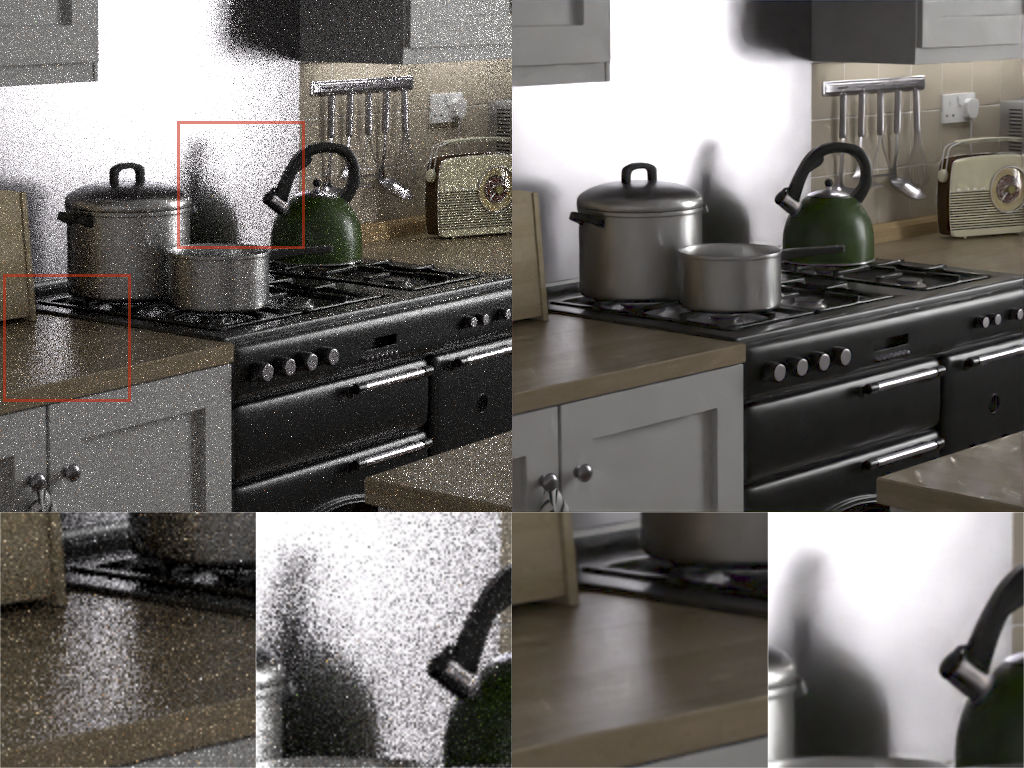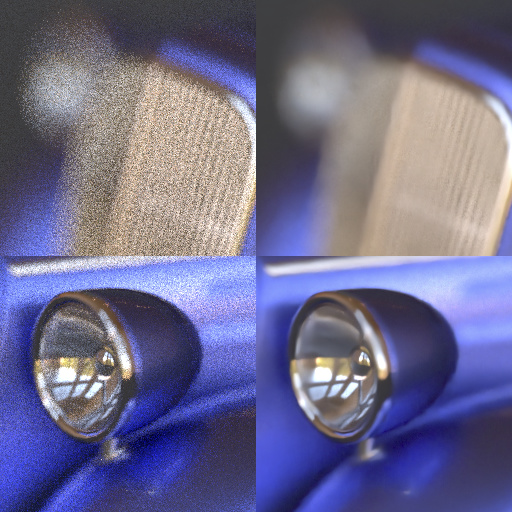
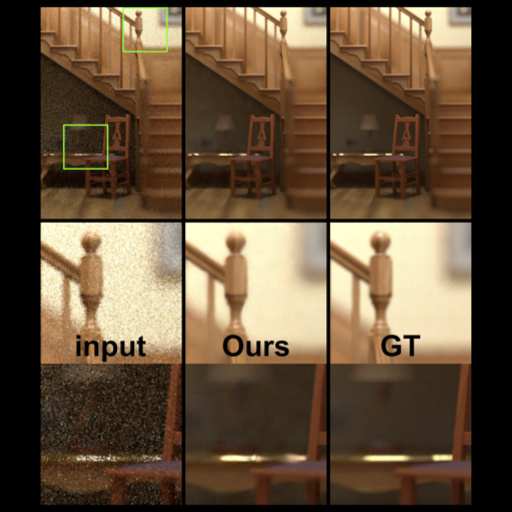
Our MC denoising research was first accepted to SIGGRAPH Asia 2018 Technical Brief, and then invited by Computation Visual Media (Open Access) for an extended article. This method proposes a filter-free approach which generates denoised image directly via a ResNet using multiple common AOVs or image channels as inputs. This method works extremely well for images with depth of field and/or high frequency features. There was an enourmous amount of effort spent in dataset preparation.
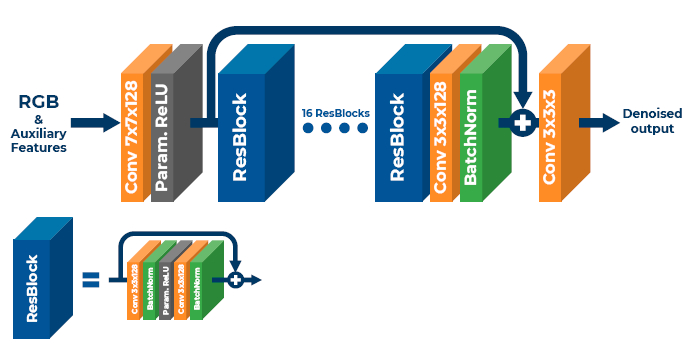
Our Denoising Model Architecture
[ Abstract from our CVM paper ] Learning based techniques for denoising Monte Carlo renderings have been shown effective recently. But, there remains a quality gap from the state-of-the-art handcrafted denoisers. In this paper, we propose a Deep Residual Learning based method that outperforms both the state-of-the-art handcrafted denoisers and learning-based denoisers. Unlike the indirect nature of existing learning-based methods (such as estimating the parameters and kernel weights of an explicit feature based lter), we directly map the noisy input pixels to smoothened output. With such a direct mapping formulation, we demonstrated that even a simple-and-standard ResNet and three common auxiliary features (depth, normal, and albedo) are sufficient to achieve high-quality denoising. This minimal requirement on auxiliary data simpli es both the training and integration of our method into most production rendering pipelines. We have evaluated our method on unseen images created by a different renderer. Consistent and superior quality denoising are obtained in all cases.